
They, along with the National Peruvian Army, were responsible for the death of approximately 70,000 people, including many innocent civilians during all of the 1980's, lasting up until the peace treaty was signed in 1992.
The Central Peruvian jungle, my destination for this trip, was one of the hotbeds for Shining Path recruitment and activity throughout the 12+ years of conflict, and, thus, was a flashpoint for later violence and war with the Peruvian Military.
I ventured forth, anxiously, vulnerably, trembling from my arrival to this novel climate and geography, a milieu I had only envisioned in rabid daydreams and impromptu meditations. Visual clips cut from travel shows in both English and Spanish raged through my mind. The brackish waters, suffocating humidity, and perpetual predatorial surveillance.
My anxiously anticipated journey commenced from the central Peruvian city of Huancayo (10,692 ft.). Located on the perched and hugely extensive Andean valley of Mantaro, Huancayo is an ideal city to visit if you desire a feeling of the Andes without the tourist traffic of Cuzco. Its mountains are more tame and its climate slightly drier than its Cuzquenan counterpart.


Inside my stylist hotel room, where I had been staying for seven days, I was finally ready to leave. I popped my anti-malaria pill, forecasting the jungle climate and concomitant barrage of mosquitos in such an ambience. A mix of emotions flit through my head and body as I fell to sleep that night, a mix not dissimilar to the emotional chaos described in the first paragraph.
 Settled, as much as could be, inside of the Cruz del Sur busliner (once again, my favorite in all of Peru and, probably, in the entire world), we first headed north from the high mountains of the Junin Province (max. 13,475 ft.). Junin is known for its extremes: in elevation, in difficult accessibility, in frigid temperatures, and more.
 At left:
I ventured forth, anxiously, vulnerably, trembling from my arrival to this novel climate and geography, a milieu I had only envisioned in rabid daydreams and impromptu meditations. Visual clips cut from travel shows in both English and Spanish raged through my mind. The brackish waters, suffocating humidity, and perpetual predatorial surveillance.
Certainly, my habitual tendency to leap into the unknown has most always been a wonderful asset, blossoming and attracting opportunities to discover new worlds. In this current case, an entrance into the Amazon jungle was on tap. An audacious meeting that would've otherwise been shut out had I not been channeling my innate bravery.
Launching Pad
Launching Pad
My anxiously anticipated journey commenced from the central Peruvian city of Huancayo (10,692 ft.). Located on the perched and hugely extensive Andean valley of Mantaro, Huancayo is an ideal city to visit if you desire a feeling of the Andes without the tourist traffic of Cuzco. Its mountains are more tame and its climate slightly drier than its Cuzquenan counterpart.


I was lucky enough to get to know this city from my Lima-to-Huancayo bus-trip acquaintance Pamela, and her son Josue. A couple of days' touring the sights was sufficient to orient myself to this mostly toned-down city. We explored the historical and cultural sites: the impressive cathedral, a trio of churches, and one fascinating regional history museum. We also mixed it up, delving into a number of restaurants and music clubs during our evenings together.


Time for Takeoff
Dark and early, I rose, celebrating immediately that I had rested well. Refreshed, I knew that this was an invaluable boon, given the heavy, eight-hour bus descent into the jungle that lay firmly in front of me.

Along the way, we passed a place I had investigated a couple days prior. The conquistadors, like in many other parts of Peru, were very present and active in this region. The Convent of Santa Rosa de Ocopa in La Concepcion (10,771 ft.), just north of Huancayo, was the headquarters for the Christian conversion assault on all of what is today the Peruvian/Brazilian jungle (a visit to this convent is an informative and very engaging revisit to South American and New World History).

Origins of Conflict
Many centuries of attempted colonization and conversions took place here, most of which at the base were failed attempts but, for the temporary bragging rights of the Colonizers, the ending result was the historically-familiar superficial/legal "successes" of land owners and ecclesiastics, alike.

This fountain view looks out over the extensive high-altitude agricultural fields of la Concepcion, just outside of the gates of the Convent of Santa Rosa de Ocopa. Surely, those originally working these lands were none other than this lands' natives, who were coaxed or threatened into relocating to convents, missions, or outposts so as to be Christianized by the Spanish.


Satipo, with a population of approximately 40,000, is situated in an area that was originally inhabited by a combination of indigneous groups. The Ashaninka, the Piro, the Amuesha, the Nomatsiguengas, the Simirinches, the Amewakas, and the Cakintis, among others. The influences, both past and present, of all of these groups is to be left for a conversation by another, more in-the-know writer; a topic of which this writer is fully incapable of delving into. What I do know is that Satipo has its own varied history not immune to conflict.


Above:
The painting to the left depicts a priest instructing his class of natives, apparently about the geography of the natives' land. It looks as though the one indigenous person standing is an interpreter between priest and natives. The painting to the right depicts the Franciscans offering good intentions (and the Christian faith, goods, foodstuffs, and more) to the awaiting, and, in this case, very welcoming natives, who can just barely be seen with their arms outstretched in the air.

Above and below:
Christianity, like all religions, is known for being malleable. They brought the 17th century Christian faith to the jungle, but they did so in the language of the indigenous. Bright colors and natural jungle symbols so as to, at least through art and message, meet the natives half-way.


At left:
So say the Christians, both past and, perhaps, (some) modern-day: there was only chaos, brutality, murder, and cannibalism in the entire jungle prior to the arrival of the Franciscans.
Though conflict has always been prevalent everywhere, including in the pre-Iberian Amazon, some might also say, including the writer, that you would only have to replace the one head-cutting and one spear-stabbing natives, seen in the foreground, with two Spanish conquistadors or a big blotch of smallpox to have a more accurate representation of how the natives were extinguished in the Amazon region.
Which is it?

Here, to the right, we see the meeting of two cultures, two belief systems, two worldviews, different universes.
European representatives stand to the left. Indigenous delegates stand to the right. Evidently, perhaps say the artist, it was after this divine meeting, and the transfusion of holy European or Christian values and ethics into the veins of the natives, that the latter finally came to their senses and abandoned their uncontrolled and barbarous ways to become civilized, Christian citizens...(or subjects?)

At left:
The goal of the Franciscans, and the Spanish, by extension, was to spread Christianity thus forward into "LA SELVA" or THE JUNGLE.
On the map, nearly all of this expanse of jungle area, highlighted in green, was completely unknown and mysterious to the Europeans at their time of arrival to the frontier of the jungle in the late 16th and 17th century and for a long time after.
Unfortunately, such a narrow focus (read: Christianity) and monolithic, universal, one-size-fits-all belief system, that also happened to be white, European-/Iberian-originating, and Spanish-speaking, offered no space for the myriad, multiversal cultural, economical, ecological, shamanical/spiritual, social diversity of the jungle region, then and today.

The painting to the right depicts a Semana Santa (Holy Week) celebration through the streets of a jungle town during either the 18th or 19th century.
Pay attention to the tone of the painting: jovial, celebratory, harmonious. Notice the priest off to the right in the foreground, observing (and, perhaps, calculating?). This tone proffered in the painting runs in contrast to many of the reports from the 18th-20th centuries: that of relative disharmony between natives and Europeans, on the whole.

At left:
This painting sheds light on the meeting of the Europeans (to the left) and the indigenous (to the right); the latter arriving at the early outpost, perhaps mission, with the former offering goods, food, Christianity, and schooling.
Below:
The five, black-and-white photos are of native leaders, from the late 19th, early 20th centuries. The image, second from right, shows a man with what looks to be his spears or arrows. The image, at right, shows a man comfortably holding his blowgun, a necessary jungle tool.

Out on the Highway
Flowing in the Cruz del Sur for a pair of hours along the high puna, with its invariable variant of brown hues, rolling hills, and the occasional vicuña or alpaca pack, we eventually veered eastward. Falling off notably and precipitously into and through the high jungle region of San Ramon (between 10,100 and 620 ft.), then, into the low jungle city of La Merced (2,463 ft.), this region is popular with municipals, given its relatively close access to Huancayo and, thus, to the populations of Lima, via the Carretera Central, National Route 22.
San Ramon and La Merced are two examples of places known as la ceja de la selva (the eyebrow of the jungle), the initial entryway into the further reaches of the low-lying and -altitude jungle.


It was in La Merced that we took lunch. Adjusted to the stark shift in climate. And headed out anew, expectant of more lushness, further ruralness, and heavier humidity as we descended into the abysmal reaches, down along the singular, solitary jungle highway.
We, in due course, wound our way through the Junin jungle towns of Pampa Michi, Yurinaki, and Pichanaki. Eventually, straightening our bus to due south at Puerto Ipoki, 45-minutes' short of our arrival to the city of Satipo (2,060 ft.).
Feeling the psychedelic effects of having skirted through and been enveloped by the verdant jungle-scapes, the ride was a visual-sential pleasure. It was also an historical and archaeological fascination for all of the reasons to be shared now.
Satipo, with a population of approximately 40,000, is situated in an area that was originally inhabited by a combination of indigneous groups. The Ashaninka, the Piro, the Amuesha, the Nomatsiguengas, the Simirinches, the Amewakas, and the Cakintis, among others. The influences, both past and present, of all of these groups is to be left for a conversation by another, more in-the-know writer; a topic of which this writer is fully incapable of delving into. What I do know is that Satipo has its own varied history not immune to conflict.
Centuries ago, the first European inhabitants of the area were the Franciscans, by way of the Spanish, in the early 1670s. The predictable, resulting conflict between the indigenous groups and the Europeans at this time and after, continued through the rest of the 17th, into and through the 18th and 19th centuries. This face-off between outsiders and insiders is typical in any frontier or colonial situation, and is documented throughout Spanish America, from Alaska to Tierra del Fuego, Chile/Argentina.

Continuity of Conflict
More recently, during the 1980's and early 1990's, the Shining Path Revolutionary group was very active in this area. Looking to gain momentum in their plight for a new, free of any of the past capitalist Peru, the leaders of the Shining Path recruited in the poorest of areas and, eventually, from all over the country. Satipo, and the jungle region, in general, were thus rich areas for recruitment for the group.
The recruitment result yielded some success for the Shining Path, but, more than anything, it created an inevitable vacuum of conflict between the Shining Path and, eventually, the Peruvian Military, with many, many innocent people caught between.
Once the two sides were on full bore, this extremely chaotic and deadly war to weed-out culprits on whichever side of the affair, be it revolutionary or military, went on for over a decade through most of Peru. Families, communities and the bonds of each were thrown into question: who was Shining Path? Who was not? Most often, mistaken identification was made or just outright framing was opted for. It's estimated that around 70,000 Peruvians died in total during the conflict, many of them indigenous people, both from cities and rural provinces. For those that didn't perish, all, invariably, lost loved ones.


At left:
Peruvian Military special forces train in the jungles, post-conflict. Even though victorious in having mostly extinguished the Shining Path and capturing its leaders and subordinates, their presence and actions, especially during the presidency of Alberto Fujimori, throughout the country have been called into question given the harsh methods of quelling the enemy. The Military is blamed for the murder of thousands of innocent civilians during its extrication campaign against the Shining Path.
At right:
A rip-off of Maoist propaganda, the Shining Path simply superimposed Abimael Guzman's image in place of Mao Zedong. The propaganda reads: "5 años de guerra popular!! (5 years of popular war!!). Five years was the estimation of how long it would take the Shining Path revolution to conquer and erase the Peruvian government, and all of its supporters and entities. From there, the vision was of utopia.

At left and below:
The Shining Path intentionally targeted areas where they thought they could rally the most support. Therefore, mostly rural, poor, and indigenous-populated areas, like Satipo, and the jungle, in particular, were their target areas for recruitment. In the end, what remained was utter frustration in all cases. This uncomfortable and unsettled feeling still bombards any visitor to this distant jungle city.
Below:
Abimael Guzman, the founder of the Shining Path is seen in jail, where he's been for the last 28 years. He, and a group of others, started the Shining Path when he was a professor of philosophy at the University of Huamanga in Ayacucho, Peru. He understood the cultural, economic, and social divide between cities and the provinces, which created leverage in recruiting (and coercing) a large number of indigenous followers to his cause.


Whilst traveling with open mind and positivity anticipated, one finds breaks and good fortune always handy. Opening my guide book to the "Satipo" section of the page, I pointed to the first hostel that came into view. It read: "Hostel San Jose." "Great!" I celebrated, internally, connecting the dots of this hostel's saintly name to that of my Californian birthplace.


My first impression was that we were going to check out the night life by foot or, at most, by the luxury of the rickety rickshaw ride. But, as it turned out, in place of calluses and hilarity, respectively, I was in store for much, much more; a ride on the back of my new friend's moto was the call of the night!
I followed the Satipoan man's order, mounting the little space left on the tail of the moto. There was, luckily, a metal-bar support to grab onto at the caboose of the bike instead of the always suspect Ace and Gary method of "Engage and Conquer!" For Goodness sakes... So off we went, separate yet together, like Don Quixote and Sancho Panza. Okay. Enough!


Carlos started off the conversation telling me about his experience as a sociologist in the region and his work with various indigenous groups. After studying in Lima and working there for a number of years, he decided to return to his native Satipo after having missed the ambiance of the jungle. I listened intently as he discussed some of the current issues that affected the realities of inhabitants in the area.
He asked me about my interest in the area. I told him that I had studied Cultural Anthropology and that my main interest was Peru. He quickly interjected (or interrupted), telling me that it was necessary to visit the farther reaches of the jungle region so as to connect with some of the rural indigenous groups. The Ashaninka, as discussed before, were the main group in the Satipo area of whom Carlos was familiar. He told me he knew a number of Ashaninka who lived in the further reaches of the jungle, and that I would have to return one day to visit them for at least two months. Being excited, and a bit skeptical, I nodded my head, letting Carlos pitch his ideas(/sales?).
We finished up our dinner, and I told Carlos that maybe one day I'd return. He gave me his phone number and told me to contact him in advance so that he could plan to take the necessary time off work to join me. Unsure of my new friend's sincerity, I politely affirmed that our tentative-at-best plans were a possibility, even though I questioned everything from the method of travel, to its cost, to even the real possibility of it ever happening.
I was given the check after Carlos' gesture to the waiter, as if to say "he's got it." I hesitantly paid after rationalizing the equation as: a moto ride for dinner. "Fair enough," I told myself only to calm my reactors to my new friend's questionable manners. We thanked the staff and left the restaurant.
Carlos and I took a few different streets back in the direction of Hostel San Jose. He told me of all of the beautiful girls that blessed the region and invited me to pay attention because of their "easiness" especially with gringos. I laughed off his caution and, as we sped on, I continued my enjoyment and overall contentment with my first night (ever) in the jungle. I got off the bike back at the San Jose as Carlos wished me luck for the following morning excursion to the deeper jungle. I thanked him for everything and within seconds my first jungle friend sped off into the dust-ridden streets of the faintly-lit city.
I went to bed that night with a mix of feelings, anticipating the exciting and really unpredictable day (or days) that were to come.


The landscape was beautiful. Our bumpy and, at times, jarring journey offered us a fascinating look into this previously unknown territory. The jungle houses and structures, raised five feet or so off the ground for purposes of flood, were all mostly identical in style.

She told me of her trucker husband. He doesn't come around much since he travels often to Lima, which is more or less on the other side of the continent to these people. After having moved from Lima herself a few years earlier, Carla was finding it difficult to adapt to the loneliness that went with living in the jungle. For this reason, she made a great day partner for an equally lonely gringo traveler! 


Below: Chicken or Rooster?


 Though, we would have another, unexpected member join our expedition. In addition to the four humans on board, the group was blessed with the presence of Canela, Carla's Toto-like side-kick.
 I continued to take pleasure in the sensation of the canoe ride. I found it to be very freeing in that, again, like the taxi ride earlier that morning, I entered into a meditative, trance-like state with the continuance of the boat's rhythmic "thump, kush, thump, kush..."

Soon after our trifecta was formed, the trail dropped down a long slope. Apparently, Michel had considered this at the moment of making the decision to return to the canoe. As we would find, this slope, which was steep and slippery, would have been impassible for Michel. In fact, the three of us each had our difficulties while descending the trail; all of us at a certain point fell onto the wet yet compact trail.




Returning back to Puerto Ocopa, we came upon a busy crowd of men fording two huge dump trucks on flat rafts from one side of the river to the other. Michel paused briefly to cede to the more pressing task at hand. Once the truck driver drove his machine onto dry land, we commenced forward to the same area.


A few minutes of conversing over the topic eventually led to a lengthy pause. Juan, our trusty driver, finally spoke up after first having turned to Martin. He said to me, "To tell you the truth, we thought you were CIA." Upon hearing Juan's statement I immediately reacted with laughter. Nothing else came out.

Satipo, Puerto Ocopa, and the other in-between spots on my jungle trail were very much worth the effort. Afterwards, I felt like I had covered much more than I originally sought out to. I touched various realms of observance and experience, through the varied lenses of a sociologist, a local restaurant-owner, an orphaned child, and a military man. It's safe to say that without my ability to speak Spanish and my deep innate passion to connect with these people, it would've been next to impossible to even attempt to understand their various realities.

I thought back to what I told Mariela and the others in the restaurant, "One day I will come back." This is a common response made by strangers from distant lands who travel to places such as this; often the unspoken promise is: "And if I don't come back, I will be sure to tell the rest about you." This "promise" has an inherent expectation, on the part of the "visited," which relates to being heard, having a voice, and, in the end, having realities change for the better. To this conundrum, the Anthropologist's Dilemma, I must say that my writing is an attempt to pay homage to these people who so willingly showed me their lives, let me participate with them, and taught me so much about life on all levels of experience. And for this, I am forever grateful.
Copyright, Patrick Roseblade 2021.

Below:
The map of Peru shows the four ranges of years when the Shining Path was prevalent and active. The darkest yellow, 1981-1984, is highlighted around Ayacucho, the birthplace of the Shining Path. Next, from 1985-1989, the central highlands, north and south of Lima, the Lake Titicaca region, and the jungle areas near Puerto Maldonado. In 1990, all yellow areas were included. And today, currently, the area to which I was traveling, interestingly enough, was, per this map, apparently saturated with Shining Path ideologues.

Satipo is also home to the Ashaninka and other smaller indigenous jungle groups; these groups have been notorious throughout history for resisting and rebelling against the infringement of outsiders, be it the Incas, the Conquistadors or the Peruvian Government. Conversely, the outsiders have been equally hesitant to venture into Ashaninka areas due to fear of not coming back. Like many conquistadors, explorers, and travelers alike have said over the last five-hundred years, "It's easy to get lost in the deep jungle."
Touchdown in Satipo City
For all of the reasons expounded on above, I nervously exited the bus I had just spent the better part of eight hours. We had exhilaratingly descended from the thin air of the high Andes to the middle altitudinal reaches of the central Peruvian jungle.
For the practical-minded: we had gone from cool, brisk highland air, to a sticky, humid, dungeon!
It was a quarter after 4 p.m. Everything within my field of view was new, exciting, and foreign. The combination of moist soil, foliage, and air. The high-reaching, multi-layers of canopy, like natural skyscrapers, hanging over head. The exotic, curious ethnic make-up of the inhabitants. The bare-bones and tinny buildings and homes.
Whilst traveling with open mind and positivity anticipated, one finds breaks and good fortune always handy. Opening my guide book to the "Satipo" section of the page, I pointed to the first hostel that came into view. It read: "Hostel San Jose." "Great!" I celebrated, internally, connecting the dots of this hostel's saintly name to that of my Californian birthplace.

So off I went. I hopped into a parked rickshaw whose insistent driver lived up to his description even more so on the road. As the photo to the left displays, we hurriedly ventured off a few blocks into the distance.
The Spanish grid-patterned layout typical of most city/towns in Peru was that of Satipo's as well. After taking a shockingly late left turn, we had barely finished our straightening-out maneuver when the driver abruptly stopped. I promptly paid and hopped-out of the jungle-vehicle, determined to enjoy that promising feeling of solid ground and control reclaimed.
I immediately looked up. The large, two-storied hostel, by my judgement a rarity in these parts, seemingly offered just the comfortable, sanctuary-like amenities I sought. I walked toward the front door and entered the San Jose.
Inside, I greeted the female attendant, inquired of any single-bed vacancies, and subsequently followed her to its whereabouts. After being awarded the keys, I thanked her and entered the room, relieved. Relieved, because there is nothing like the sense of completion and security one feels after having set his/her belongings down in the certainty of one's hostel following many hours of travel and its concomitant uncertainties.

In, as it turns out, my drab and windowless room, I rested for some time, regaining my composure. Then, still lying on the firm-as-a-board bed, I grabbed my guide book. As I read about the "excursion options" in Satipo, my attention focused in on one of particular interest: a five-hour morning journey to the small port town of Puerto Ocopa, three hours' tour from Satipo. I spontaneously decided to go.
I swiftly grabbed my wallet and proceeded to the front desk. There, I inquired about the excursion and was quickly and familiarly informed, not by the attendant girl, but by her very knowledgeable friend. Actually, to put it best, her friend, a forty-or-so year old local man, exploded into an informational spiel that more than satisfied my inquiry. He covered everything from time, to location, to destination, to what to expect, to pretty much everything. In seeing that I was content with his monologue and sure of my day-trip on the morrow, he asked if I had seen the city yet. I replied, "no," and after accepting his offer to show me around the city, we exited the hostel.
My first impression was that we were going to check out the night life by foot or, at most, by the luxury of the rickety rickshaw ride. But, as it turned out, in place of calluses and hilarity, respectively, I was in store for much, much more; a ride on the back of my new friend's moto was the call of the night!
I followed the Satipoan man's order, mounting the little space left on the tail of the moto. There was, luckily, a metal-bar support to grab onto at the caboose of the bike instead of the always suspect Ace and Gary method of "Engage and Conquer!" For Goodness sakes... So off we went, separate yet together, like Don Quixote and Sancho Panza. Okay. Enough!

What a rush it was to cruise through the dirt streets of this alien jungle town, winding our way through the various city blocks, seeing just what this city was made of. I saw numerous restaurants represented by the steam-wafting stews always present at the shop entrances. Couples and families tooling through the streets on their way to myriad places and the simultaneous cries and laughs of their youngsters in normal states of fight, flight, or delight.
In my view, and in spite of my normal anxieties when traveling, it appeared that there was an underlying sense of peace in this city. An easy-goingness, a calm, maybe originating from the people, or, as I honestly feel now, stemming from the inherent calm found in all natural jungle surroundings. My friend and I continued our journey through the main plaza of Satipo, eventually coming to a stop just a few doors down from the border of the main plaza.

We dismounted the bike and entered the restaurant situated in front of where we were parked. It was a normal looking Peruvian deli/restaurant with a bit of a generic look to it (very normal in Peru, haha!).
We took a seat at the soon-to-be only occupied table in the joint. Carlos then formally introduced himself to me and we shook hands. He quickly ordered us two sandwiches and two Inca Kolas. Only after-the-fact did he check with me as to my consumption preference. Just letting it be, I figured he knew what was good given his nativity to the city and knowledge of all of its hot spots.
Carlos started off the conversation telling me about his experience as a sociologist in the region and his work with various indigenous groups. After studying in Lima and working there for a number of years, he decided to return to his native Satipo after having missed the ambiance of the jungle. I listened intently as he discussed some of the current issues that affected the realities of inhabitants in the area.
He asked me about my interest in the area. I told him that I had studied Cultural Anthropology and that my main interest was Peru. He quickly interjected (or interrupted), telling me that it was necessary to visit the farther reaches of the jungle region so as to connect with some of the rural indigenous groups. The Ashaninka, as discussed before, were the main group in the Satipo area of whom Carlos was familiar. He told me he knew a number of Ashaninka who lived in the further reaches of the jungle, and that I would have to return one day to visit them for at least two months. Being excited, and a bit skeptical, I nodded my head, letting Carlos pitch his ideas(/sales?).
We finished up our dinner, and I told Carlos that maybe one day I'd return. He gave me his phone number and told me to contact him in advance so that he could plan to take the necessary time off work to join me. Unsure of my new friend's sincerity, I politely affirmed that our tentative-at-best plans were a possibility, even though I questioned everything from the method of travel, to its cost, to even the real possibility of it ever happening.
I was given the check after Carlos' gesture to the waiter, as if to say "he's got it." I hesitantly paid after rationalizing the equation as: a moto ride for dinner. "Fair enough," I told myself only to calm my reactors to my new friend's questionable manners. We thanked the staff and left the restaurant.
Carlos and I took a few different streets back in the direction of Hostel San Jose. He told me of all of the beautiful girls that blessed the region and invited me to pay attention because of their "easiness" especially with gringos. I laughed off his caution and, as we sped on, I continued my enjoyment and overall contentment with my first night (ever) in the jungle. I got off the bike back at the San Jose as Carlos wished me luck for the following morning excursion to the deeper jungle. I thanked him for everything and within seconds my first jungle friend sped off into the dust-ridden streets of the faintly-lit city.
I went to bed that night with a mix of feelings, anticipating the exciting and really unpredictable day (or days) that were to come.

"Gooood Morrrniiiing Satipoooooo!" rang through my head as I received my far-too-early intro to the day. It was 4:30 a.m., an unheard of and unseen reality as far as my travels go, and I was surprisingly ready (after a few minutes of breathing and stretching) to embark on this crazy journey further into the jungle. I dressed quickly, put my things together, and sat down to calm and collect myself. Next thing I knew it was 5:15 a.m. I exited my room and went down to the lobby. The car was waiting outside with three other passengers in it. I entered and said hello to the driver and my three co-venturers. Our taxi scooted on.
Our initial attempt to exit Satipo was stunted in quite a shocking way. As we traveled down the usual road that cuts through and eventually out of Satipo, we were abruptly stopped by three heavily clad men carrying machetes and guns! If I wasn't fully awake prior to this occurrence, you better believe that I was afterwards!
Our initial attempt to exit Satipo was stunted in quite a shocking way. As we traveled down the usual road that cuts through and eventually out of Satipo, we were abruptly stopped by three heavily clad men carrying machetes and guns! If I wasn't fully awake prior to this occurrence, you better believe that I was afterwards!
I quickly felt out the reactions of my friends in the car, for they were, needless-to-say, alarmed. The weapon-toting men demanded a reason for our presence on their road. Our driver pleaded to the inquisitors of our innocent. We were authoritatively instructed to take the alternate route or suffer the consequences. Our driver apologized and, without pause, punched the car into reverse and headed in the opposite direction.
In fact, he didn't let up on the accelerator for the next two hours! Although I'm still unsure of his motivations for this, I would imagine that until we safely excited Satipo, via our alternate route, part of his hurried motivation was literally to escape to freedom! In any event, our trip had commenced, en route to Puerto Ocopa.

The leisurely disposition of the people, matched equally in dress, was very apparent as most entrances to house and store alike were guarded by somebody. I watched very attentively as we passed through these old villages that most definitely held much history and lore. My co-venturers kept to themselves for the most part, only speaking briefly, while mostly watching and "meditating" in the semi-trance state brought on by our shaky and tremor-like ride.

We descended deeper into the jungle basin, as the space between towns expanded as did the space between houses/shacks within each town we came upon. After hour two, I knew our destination was approaching quickly. My anxiety struck me in large and energetic pangs. I was truly testing my boundaries with this trip, so I started to really focus on breathing, reassuring myself that all was well. After all, I was in a truly beautiful place, albeit foreign in cultural and geographical terms.
Welcome to the Jungle: Puerto Ocopa
Welcome to the Jungle: Puerto Ocopa
The taxi calmly pulled into our destination town. As the parade of chickens and dogs cleared out with our push forward, we finally came to a halt in front of an area where a crowd of people waited. I felt an intimate episode of self-consciousness as it seemed that all eyes peered over me, the only gringo within one hundred miles...
I nervously got out of the car. Taking my backpack, I purposely walked in the direction opposite the mass of thirty-or-so people, eagerly waiting near the water's edge.
I nervously got out of the car. Taking my backpack, I purposely walked in the direction opposite the mass of thirty-or-so people, eagerly waiting near the water's edge.
As I walked, the name of the town came to mind: Puerto Ocopa. It only then occurred to me the reason for all the raucous: we were at a puerto, a port! Probably a pretty important place, I surmised, for the people and commerce of the area.
I pressed on. As I did, I observed the long strip of shacks housing businesses and homes along either side of the dirt road of Main Street, Puerto Ocopa. A hundred steps' toward the river crossing, or a half-block down from the noise, I decided to seek refuge in a river-front restaurant.
 I bowed my head under the wood crossbeam as I entered the restaurant. This is a common defense, familiar to many taller gringos traveling in "these parts." I put my backpack down and sat at one of five tables in the simple and vacant eatery.

I saluted the middle-aged woman who surprised me when she peeked her head through the hole that connected the kitchen to the restaurant. She quickly cleaned her appearance and walked out to greet me.
"Buenos días, cómo estás?" We both simultaneously affirmed and asked as our eyes met. The, now, apparently, less-than middle-aged, and quite lively woman handed me a menu. With some time, I told her of my rookie status as far as the jungle goes and of my intentions of going further into its reaches in the days ahead.

My waitress/cook offered her name, and, surprisingly, a confession as well. As she sat down in the hard-plastic chair next to me, Carla divulged that she was new to the area and had little knowledge or explorational experience in the region. Struck by this immediate openness, of which I hadn't previously observed in other parts of Peru, I equally opened up.
During the next five minutes, we spoke of many things, kick-starting a new friendship and excursion partnership. At the five-minute point, Carla informed me of the solitary special of the day, Sopa de Gallina (chicken soup). I gratefully accepted, and we recommenced our talk, which occurred now through the hole that separated restaurant from kitchen.

We conversed for a few hours, sharing our experiences from such distinct poles of the world. Naturally, she had a number of questions to ask me of my origins. To no surprise either, another Puertoocupan got involved. A girl of twelve, Mariela, stopped by in passing. At that moment, our company grew to three. And, after initial introductions and the like were established, we agreed to go on an expedition down-river to a set of cataratas, or waterfalls, that were, according to my two teammates, "a wonderful sight to see."
In no time, my sojourn at the port in this company of three had abruptly shifted to a mobile expedition into the unknown depths of the Central Peruvian jungle! The coin of emotional opposites reappeared, like it had upon starting this brave journey and while entering into the novelty that was the Satipo area. This time, my exhilaration won-out, quelling the fear that formerly dominated.
Within a few minutes, Carla, knowing all of the town's inhabitants, got in contact with Michel, a local canoe driver, and our soon-to-be guide, to negotiate plans. In the meantime, I took a short excursion out on Main Street, just outside of the eatery for some sight-seeing.
Below: A monkey, chained to the front fence, retreats in defeat. His hunched, huddled, and frustrated demeanor are fitting given that his incessant calls for freedom invariably fall upon deaf ears.

Below: Kitty. Resting in the shade.


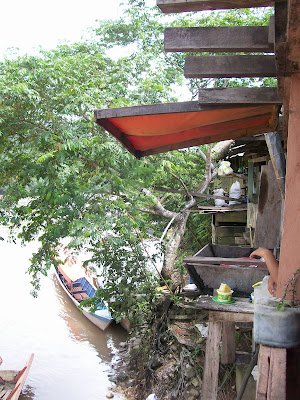
Below: The calm, soothing, unceasing river flows along the shores of Puerto Ocopa.


Rollin' on a River
My initial introduction to Michel was a bit stiff. It was a classic example of a water and oil situation. Michel, a twenty-something gimp from the area, evidently didn't take kindly to my easy-going and loose Californian (or gringo) attitude. Even so, I invited him, through my demeanor, to be my friend. He, on the other hand, wasn't so welcoming.
This was further evident when I asked Michel the going rate for a ride to the cataratas, or waterfall site. In keeping in mind that the trip was quite short, maybe three miles round trip, he affirmed, straight-faced, "1,000 soles." Or, in American terms, approximately $300! Gas alone was probably fifteen soles (or $4-$5) if that, plus his service. I, on the other hand, thought no more than 100 soles would be sufficient for the entire package.
After a bit of razzing from Carla, who could have almost be considered his sister given the intimate reality of their town, Michel capitulated. Our service charge for the expedition would be 150 soles. "Fair enough," I said, shaking my guide's reluctant hand.
And we were off!
By this point, a crowd of onlookers was developing in the vicinity. I, however, was fixated on the whereabouts of Michel's boat and its current condition. We climbed down to the water's edge. There, perched up on the dirt, was the good-shaped and floatable water vessel. That's when my underlying excitement became fully manifest. Carla, Mariela and I promptly climbed into the long canoe in anticipation of our river adventure.

This cinnamon-red mix was as eager as anyone on board. She unhesitatingly balanced herself by propping her forelegs upon a cross-board of the well-battered canoe. Only if she had her water-goggles and cape to finish her boating wardrobe...
Michel performed what appeared to be his customary preparations for the ignition of the engine. And, "boom!" we were ready for cruising...
Our preliminary chatter subsided with the onset of the noisy engine. What was at first an auditory assault, eventually, settled as the refreshing sound of boat smacking against the river waves and wakes took hold.
The Río Perené is one of many affluents to the great Amazon. The Río Perené actually joins with the Río Ene at the confluence of the Río Tambo downstream in Puerto Prado. From there, the Río Tambo winds and flops for hundreds of miles in an easterly fashion until joining forces with the Río Urubamba in Atalaya, where the Río Ucalayi assumes the job. This beast of a river is like a fully stretched and pulled Slinky in shape, unveiling itself in a south-to-north direction from central-eastern to northeastern Peru.
Just miles downstream from the monstrous jungle metropolis of Iquitos, at the confluence of the Río Ucalayi and the Río Marañón, the Amazon, that gargantuan land-dwelling sea in the form of a river, officially commences. (I recommend a Google Map search of the wild courses of these rivers.) My imagination ran rampant with geographical daydreams of questing along the entirety of the course just outlined. This, as well as venturing to the accompanying towns and cities along the river way shot through my being as possibilities for a future return to the area. In the meantime, subtle, building sounds of boat to river crept back in.

This, mixed with the incredible and novel views of our lush surroundings, was exactly the adventure I was looking for prior to my decision to even go to the jungle region in the first place.
In fact, at this point in my adventure, I was ready to keep pushing further and further into the unknown realms of the Amazon region. No guide books go there, save a few sentences here or there regarding a few locations along the Amazon once it's reached. Where we were at this point was where my Lonely Planet ended!
In a sense, given the popularity and worldwide usage of Lonely Planet (and others like it), I was at the end of the "known world." Everything ahead was to be a mixture of word-of-mouth and pure improvisation!
 With these alluring ideas baiting me on, we pushed ahead enjoying the wind, water, and sights of this jungle paradise. I found myself trying to look up through thick shore shrubbery so as to catch a glimpse of potential presence of forest-dwelling inhabitants.

All of the books that I had read during my formal and informal studies came to a head at this point, as I fantastically entered into an imaginary setting in which one of my college professor's was my guide through these areas of which he knew all too well. In this daydream realm, Professor Varese and I chatted about our location, its history, its present and much more in a mutually enthusiastic and agreeable way.

I quickly snapped out of this state with our abrupt deceleration and consequent coasting of the canoe after Michel pulled the plug on the engine. With impeccable timing and technique, he guided us to a small area of beach just along the river. We softly touched up to the beach, where we took our life jackets off, and exited the boat.
 After thanking Michel for his skill and safe-maneuvering, we excitedly entered the "bush," whose mysteries immediately waited for us just off of the beach area.

Through these imaginations, much of the topics discussed earlier flooded, and eventually began raging through my mind. Were there still Shining Path revolutionaries in the area? What about the Peruvian Military Special Forces soldiers? Not to mention, the cocaine industry and all of its potentially violent byproducts, like narcotraffickers and such... The fear raced through me as the sound of the boat's motor built in intensity, now roaringly exceeding its previous decibel level.

Michel led the way to our trail which would lead us to our eventual waterfall destination.
At first, our pace was slow; not due to inability, but due to the lack of functioning of one of Michel's legs. I never asked him what had happened, but he was only able to use his right leg as an untrusty-at-best support.
His system was that he stepped with his good leg, his left, and swung ahead his right, apparently "dead," leg with the help of his hand pulling on his pant leg.
Given his circumstance, he did very well at this. But, after a good fifteen minutes of walking through the lush, wet, and getting to be slippery surface of the trail, Michel had to bow-out. Carla, Mariela, and I parted ways with our guide and told him we'd return in an hour or less.

Soon after our trifecta was formed, the trail dropped down a long slope. Apparently, Michel had considered this at the moment of making the decision to return to the canoe. As we would find, this slope, which was steep and slippery, would have been impassible for Michel. In fact, the three of us each had our difficulties while descending the trail; all of us at a certain point fell onto the wet yet compact trail.
During it all, the one thing that was reassuring was the closeness of the river below. As we pressed on through the vibrant and increasingly humid jungle, the river came into view; a sight that we celebrated given our arrival to the water's edge all in one piece. The lush jungle-scape opened up before our eyes. We were here!
With the space now available by way of the river clearing, we were privy to all of the typical views to be expected: a calm-running river, multi-layers of trees and nearly impenetrable shrubbery. We also noticed the echoes of birds and monkeys, and the noises of insects, all arriving from near and far.


Probably the most notable of all jungle characteristics was the strange and nerve-racking feeling that we were being watched; if not by a slithery or creepy friend moving at our feet, then by a deceptive jaguar in the many shadows of the forest! The fears that previously gripped my world: the communist revolutionaries, the well-trained military killers, the unforgiving narcotraffickers, receded to the power of more pressing, primal concerns, potentially lurking in the forest.
Once I identified and dismissed these feelings of fear as being a variable out of my control, I was able to directly experience the magic of this environment. After all, this was my first time in an actual jungle. The place at which we found ourselves was as deep as I had ever been before, And it would be the furthest point to which I would travel in the jungle during this particular trip.
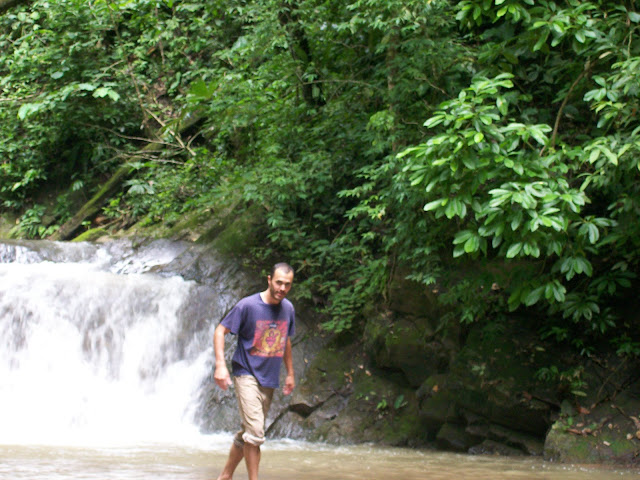
 Mariela, Carla, Canela, and I simply waded through the shallow streams that flowed away from the mini waterfalls up hill. We took turns taking pictures of each other, materializing our exciting and spontaneous adventure to a place only Mariela had ventured to previously.

The falls were utterly calming, relaxing. I had the inclination to stay for the rest of the day, as I'm sure my cohorts did as well. But, I, and by extension we, knew that Michel was patiently waiting for us on the shore of the "real" river.
So after a reluctant "let's go," we honored our guide's time as we left our timeless magic-scape and reentered the realms of normal time and space.
With a quick climb up the soggy trail, a twist and a turn, we were back to the small beach onto which the lancha was stationed.


Michel smiled while we prodded him for not having joined us at the waterfalls. It was a welcome emotional opening from a man who had hitherto only presented walls of impersonability. This caused all of us to smile vibrantly.


By the time we made it to the shore, that same busy crowd from before had for some reason calmed and assembled themselves into a single-row line in observance of our incoming lancha.

At first, I was a bit tense given that I would be no match for a group of men of their size and number. With the men looking on, I assumed a cautious stance while exiting our lancha.
I decided to break the ice, immediately. To my relief, all of the men matched my smile with one of more or less equal openness. After acknowledging the men, I approached one especially large one who happened to be wearing a New York Yankees' baseball cap. I asked the giant-of-a-man and his immediate-standing friends what they were doing. The especially large man told me that they were banana pickers and that they had been working all day far back on the other side of the river.
Soon after, they inquired about my presence in the jungles of Satipo, it was what they called a "far-out" venture for a tourist such as myself. I told them that I enjoy the far-out places because it is where I can connect with the local people more so than in the tourism-heavy places in the bigger towns and cities. While shaking the hand of this large banana worker, who had the customary light handshake of most jungle dwellers (contrary to my expectation), I thanked them for their time and we parted ways.


Mariela, Carla, Canela, Michel, and I spent a few more hours inside of Mariela's restaurant. I was set on leaving and eventually found a taxi that could take me in the direction of Satipo. Once the horn sounded, I said my good-byes to my new friends; one of which was Michel who had traveled light years from the dark reaches of foe to embrace this new gringo guy. I thanked them all, promised a return one day, and entered the taxi which subsequently sped away.
Back to Life, Back to Reality
When we finally reached the outskirts of Puerto Ocopa, the discussion began. This is when things got interesting. The driver, a sixty-something man named Juan, his friend and my fellow passenger, Martin, a forty-something ex-policeman, and I began to talk at length about the area and its tainted history.


Back to Life, Back to Reality
When we finally reached the outskirts of Puerto Ocopa, the discussion began. This is when things got interesting. The driver, a sixty-something man named Juan, his friend and my fellow passenger, Martin, a forty-something ex-policeman, and I began to talk at length about the area and its tainted history.
The small-talk eventually gave way to the big-talk. Actually, it was within seconds after having asked the last of the personal information questions, that I went right to the heart of the matter, by asking both men, "So how are things after the whole Shining Path era?"
Juan, after initially showing an attempt to tackle the question, easily gave way to the younger and more assertive Martin. The latter, frankly commented, "It was a difficult time. All of us were intimately affected by the conflict." My heart sunk in knowing that I had touched a sensitive chord in them.
Juan, after initially showing an attempt to tackle the question, easily gave way to the younger and more assertive Martin. The latter, frankly commented, "It was a difficult time. All of us were intimately affected by the conflict." My heart sunk in knowing that I had touched a sensitive chord in them.
Martin continued, looking at me through the rear-view mirror, "everybody lost friends and members of their families. All of us lost loved ones." He went on to tell me about his time as a police officer, and how it was dreadful to be involved at that level. "We (the police force) were connected to the community by blood, and to the government by contract." Martin's words reminded me of everything I had heard, read, and watched on the conflict, now being delivered in an intimate testimony.
"We had to take orders from the army, who were much more detached than ourselves." Martin then started to look back at me, directly, mirrorless, continuing, "we were forced to make very difficult decisions and take very difficult actions, all of which still tug at my heart."
Martin was referring to the fact that many civilians were thrown into question by the government as to which side of the conflict they were loyal to; quite a difficult question for many people. Many civilians had friends and family members who were part of or leaning toward the revolutionary ideas, and still others who leaned toward the government side given their affiliation with the State or to some local or regional official(s).
Martin was referring to the fact that many civilians were thrown into question by the government as to which side of the conflict they were loyal to; quite a difficult question for many people. Many civilians had friends and family members who were part of or leaning toward the revolutionary ideas, and still others who leaned toward the government side given their affiliation with the State or to some local or regional official(s).


This paints the problem for most of these civilians, most of whom weren't even given a chance to consider their true political leanings, for threats from both sides put them into a turbulent and atrocious situation. Many people died in tactical assassinations by the government, though not all were documented. Surely, in addition to Peruvian Government-related killings, the Shining Path revolutionaries too were guilty for their share of killings (for the similar reasons of uncertainty and questions of trust).

A few minutes of conversing over the topic eventually led to a lengthy pause. Juan, our trusty driver, finally spoke up after first having turned to Martin. He said to me, "To tell you the truth, we thought you were CIA." Upon hearing Juan's statement I immediately reacted with laughter. Nothing else came out.
Juan looked back at me through the car's shaky rear-view mirror, while Martin glanced back for a moment to inspect the look on my face. I responded verbally for sake of clarity and directness, "Not a chance in the world!" I continued, further reassuring both men, "I could never work for the CIA!"
Both men laughed, albeit with a hint of lingering distrust. But, after a few more comments clarifying my more progressive political leanings, they appeared to understand my civilian (and forever civilian) status.
The rest of our trip was for the most part a non-verbal one. Numerous twists and turns over vicissitudinal roads wet and dry; the majority of the ride was like a real-life Indiana Jones jeep jaunt through the jungle. This was welcome for me so as to have time to consider the significance of my presence in this region of Peru, brought on by driver Juan's confessed assumption. Prior to coming here, I hadn't given it much thought as to how these people would view me, as a white American man coming into the distant reaches of a former Shining Path (who were anti-Capitalist/Imperialist) stronghold.
Juan's statement continued to reverberate through my mind. I found it strange, in a way, due to my self-identification as a universalist and my very progressive political stance and values. At the same time, I could understand where Juan, and anybody else making such an assumption, was coming from. In their eyes, a twenty-something white American man traveling solo through the Central Peruvian jungle was something to be weary of. And then it hit me: I would've thought the same thing! For one thing, usually tourists traveling through these parts are accompanied by one or more friends for the trip. Secondly, and more hard-hitting, normally tourists don't even come here!
The taxi ride, which eventually returned me to my intended destination of Satipo, was less about the landscape and more about my journey into the contemplative reaches of my mind. I analyzed, considered, debated, and learned many things about how history (personal and shared), memory, perception, appearances and the unknown, intertwine and congeal in a way that shapes the way we live our lives and how we view our present world.
The rest of our trip was for the most part a non-verbal one. Numerous twists and turns over vicissitudinal roads wet and dry; the majority of the ride was like a real-life Indiana Jones jeep jaunt through the jungle. This was welcome for me so as to have time to consider the significance of my presence in this region of Peru, brought on by driver Juan's confessed assumption. Prior to coming here, I hadn't given it much thought as to how these people would view me, as a white American man coming into the distant reaches of a former Shining Path (who were anti-Capitalist/Imperialist) stronghold.
Juan's statement continued to reverberate through my mind. I found it strange, in a way, due to my self-identification as a universalist and my very progressive political stance and values. At the same time, I could understand where Juan, and anybody else making such an assumption, was coming from. In their eyes, a twenty-something white American man traveling solo through the Central Peruvian jungle was something to be weary of. And then it hit me: I would've thought the same thing! For one thing, usually tourists traveling through these parts are accompanied by one or more friends for the trip. Secondly, and more hard-hitting, normally tourists don't even come here!
The taxi ride, which eventually returned me to my intended destination of Satipo, was less about the landscape and more about my journey into the contemplative reaches of my mind. I analyzed, considered, debated, and learned many things about how history (personal and shared), memory, perception, appearances and the unknown, intertwine and congeal in a way that shapes the way we live our lives and how we view our present world.
After thinking about how Juan and Martin could have potentially perceived me, I thought back to Mariela and Carla, Michel, the Giant, and the others that I had met in both Puerto Ocopa and Satipo. What was their perception of the lone gringo traveler? And, given each of their individual and shared personal histories, how did they interpret my presence in their land? Did they perceive me in a similar light to that of Juan and Martin? And, if so, what does this tell me and the readers out there of the importance of understanding the history of a place and its people? And, what's the importance of understanding the influence of our countries' political and economical decisions on those places and its people? It made me also consider: just what influence do I want to have while I travel to these various places? In particular, what is my responsibility to myself, my country, and to humanity as a whole?

Food for reflection.
Satipo, Puerto Ocopa, and the other in-between spots on my jungle trail were very much worth the effort. Afterwards, I felt like I had covered much more than I originally sought out to. I touched various realms of observance and experience, through the varied lenses of a sociologist, a local restaurant-owner, an orphaned child, and a military man. It's safe to say that without my ability to speak Spanish and my deep innate passion to connect with these people, it would've been next to impossible to even attempt to understand their various realities.

Copyright, Patrick Roseblade 2021.


No comments:
Post a Comment