
Catharsis.
3:20 a.m. Visability: jet black. 45 degrees Fahrenheit, with a light breeze coming from the southeast.
The initial heaves erupted in extreme, hallucinogenic flashes. The ensuing and myriad aftershocks yielded similarly hellish results. After what seemed to be endless declarations of profound sickness, I finally reached a brief moment of peace. With an all-fours’ crawl on warm earth, the cold sweat that shot from my forehead like grease splashing from a hot skillet now settled as my temperature quickly followed suit.

From here, I had nothing more to surrender as I delighted in this blessed break from the onslaughts. I had just vomited my guts out. And, now, my concern was the acute dehydration that followed. Despite the madness, I, amazingly, still managed to find moments for humility, even gratitude. Brushing off my dirty hands, which were the unavoidable result of the uncontrollable heaves and concomitant fall to ground, I took a brief moment to enjoy my surroundings. Deep breathes of life and the accompanying mountainous visual grounded my attention both to the present and to the heavenly terrain that seemed to envelope me: omnipotent mountain peaks; abysmal river canyon; the most radical of hillside inclines humanly imaginable. Feeling a semblance of spark, I wandered forward.
Well. Scratch that. More aptly, I lunged, lethargically, confusedly, mostly aimlessly. And, as such, with my only orienting factor being the arduous incline to the heavens in front of me, the trail on which I resolved to continue, ever-so-sickly, one step at a time. To say I had heavy feet would be a gross understatement. I was the universe’s best breathing example of the walking dead!


Leading up to day four, my outlook hadn’t contained a hint of bleakness. Ironically, the previous three days of trekking through this radical terrain was nothing short of bliss. And so you may ask: At what point did it all go so wrong?!
Two words: Anti-malaria pill.


The trailhead began on the outskirts of Cachora (note: follow the direction of the donkey for three minutes), at which point a sign read: “Choquequirao, 27 km.”

Just prior to the entry point at the ominous "Point of No Return," Miky, Evelyn, and I observed Mount Veronica, the highest peak in the Urubamba Mountain Range. With frozen glacier firmly intact to and enveloping its peak, frigid clouds mischievously obscured our visibility of Veronica. Her celestial grandeur fell precipitously to the invisible, abysmal floor of the Apurimac River Valley far below. This same river valley, the Apurimac, is said to be one of the deepest in the world. Upon witnessing this surreal phenomenon, our rampant conversation halted as we gloriously submitted to the unspeakable beauty before us. Just then, I got the chilling picture that we were about to embark upon something far more involved and much greater than previously expected.

The first steps through the threshold of "The Point," formally known as Capuliyoc, were hallucinogenic. The sun’s light-and-shadow play on the mountain-scape was so surreal that it couldn't hope to be replicated by even the most talented of Hollywood set designers. The same gargantuan mountain steeps characteristic of Mt. Veronica, were omnipresent and ran the entire length of the valley from right to left, on both sides (or “walls”) of the river valley. The sky was as blue as it gets, with subtle clouds gracing the myriad glacial peaks on either side of the two gloriously long mountain ranges.


Feeling subtly disoriented, due to the fatigue of the climb and a recent onset of fright, I nodded in recognition as he laughed in delight. He went on to confess, enthusiastically, "Me gusta hacer juegos de todo! (I like to make games out of everything!)" His playful comment made me giggle, as I continued my weary search for respite. Eventually, I found it in the form of a long-stretching bamboo bench with a matching shade cover hanging over it.

Julian, the Apurimac man, uncannily resembled the great Mexican singer and songwriter, Juan Gabriel. That brilliant composer, performer, icon to many Mexicans and Latinos, more generally. Come to find, after my attempts to hope for it to be possible, it wasn't to be; Julian just wasn't Juan Gabriel.


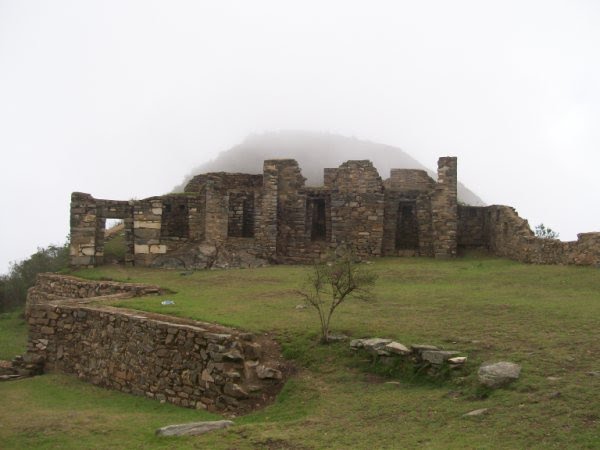

The next several hours were spent calmly strolling through the various areas of the site: the well-perserved and -mantained houses, courtyards, temples, and ceremonial grounds. The fog eventually dissipated, offering us a perfect view of not only the ruin site, but of the rest of the unimaginably distant valleys that extend away and down in all three directions from the nucleus that is Choquequirao.
In actuality, the initial “quakes” began at the second night’s campamiento. The bad stomach came not on the third night but during our calmly tour of the Choquequirao site. The grand tipping-point occurred only after a tuna cake supper at our third night’s campamiento (same as the first night’s, on the first “wall”). At 3:25 a.m.-sharp, I arose and exited our tent, for that’s when the intense pangs and nascent heaves became spontaneous and uncontrollable. The same cold sweat, mixed with bile-fueled eruptions, that would rule me the following day were just beginning; this was only a warm-up for my terrible, precipitous and imminent fall from bliss.


Well. Scratch that. More aptly, I lunged, lethargically, confusedly, mostly aimlessly. And, as such, with my only orienting factor being the arduous incline to the heavens in front of me, the trail on which I resolved to continue, ever-so-sickly, one step at a time. To say I had heavy feet would be a gross understatement. I was the universe’s best breathing example of the walking dead!
Two minutes through the “death stroll,” I needed to rest again. And, after a couple more lifeless steps, I did so. It was on a series of small rocks at the trail's edge, where I sat, rested and contemplated the prospects of my life. Shortly thereafter, I drearily noticed a man walking in my direction on the trail below. The energetic, 30-something man approached. It was no miracle that he immediately inquired as to my condition, in seeing that I was in all likelihood horridly pale and suffering.
His empathetic reaction to my sorry state was offered in his concern for my life as well as in the form of a granola bar. The currency of care for hikers. Thus, I accepted, graciously. He then reached for an extra water bottle from his pouch. I thanked the kind man, satisfactorily conjuring up a meek smile.
Before his departure, he queried, "Oye! Vas a estar bien?! (Hey! Are you going to be okay?)" I mustered a mutter: "Sí, estaré bien. Gracias por todo... (Yes, I'll be okay. Thank you for everything...)" We went on to engage in a game of look sharing and nods, with the solitary aim being to establish some form of assurance. Once the man was sufficiently assured, he, as if directly connected to the fountain of youth, skipped on. While, I, in stark contrast, could do little more than watch him hop away, so annoyingly effortless.
Soon after, feeling more sparks that now almost resembled a charge, I opted to make yet another desperate attempt. This time, surrender was setting in, I would thus tread lightly, while immersing further into the sickness-inspired hallucinogenic trip.
Soon after, feeling more sparks that now almost resembled a charge, I opted to make yet another desperate attempt. This time, surrender was setting in, I would thus tread lightly, while immersing further into the sickness-inspired hallucinogenic trip.
As I ambled along, I wearily observed the trail’s dry, amber-colored earth with hints and tints of vibrant illumination. The steep mountain side, stretching from so high above, to deep down, abysmally down below, had the same psychedelic effect. I peered over to the distant outlying mountain peaks, so enormous in size, and many of them with glacial caps, as they gloriously exalted into the sky.
The sun’s rays began to weigh down upon me as the temperature simply exploded. My “sweats” turned from cold to hot and quickly back. Light-headedness breached and gripped me, unerringly, for the rest of the day. And so I could safely claim that it was indifference that marked my experience on this fourth and final day of my trek to Choquequirao, the blessed(?) sister of Machu Picchu. The Inca ruin site located four hours southwest of the city of Cuzco, the former Inca capital.


Leading up to day four, my outlook hadn’t contained a hint of bleakness. Ironically, the previous three days of trekking through this radical terrain was nothing short of bliss. And so you may ask: At what point did it all go so wrong?!
Two words: Anti-malaria pill.
And, well, a couple more words: Consuming malaria pill after eating tuna. That’s a “no-no” in the worlds of biochemistry and trekking, and the formula for a chemical reaction that yields grave results in a matter of minutes. You may also ask: Could you have avoided this situation, altogether? A simple response: Yes. But, the reasoning behind my precautionary consumption of the anti-malaria pills actually sheds light upon the divine, dynamic and microclimate-shifting magnificence of this four-day trek adventure through the heart of the Peruvian Andes.
The Divine Adventure: Origins, and the Descent of the First “Wall of Eternity”
I met Miguel Angel Delgado Choque when I was making my way to the “Lost City of the Incas,” Vilcabamba, the previous year. We met in the small, Inca trail hub town of Huancacalle (in the Cuzco Region of Peru), where Miky (SIC; a nickname self-coined after the legendary Rolling Stones’ front man) was working/trekking while documenting trail locations and various measurements for the Cuzco Regional Government. We talked briefly, exchanged information, and I, after sensing his integrity and experience, promised to call the following year during my planned return trip to the Cuzco area.

Fast-forward one year.
Miky, his girlfriend, Evelyn, and I sat while enjoying the long and windy bus ride through the breath-taking Abancay Province of the Cuzco Region. Gazing out on this beautiful terrain that is the heart of the Andes, I commented to myself for only the second time in my long history of trips to Peru, “Now this is Peru!”
We eventually reached our stop at a small town where we promptly exited the bus. There we stood, high atop a panoramic lookout with views of quintessential Andean majesty. We calmly considered our next move.
Whilst the cool Andean air passed through my hair, at one point nearly smothering me with its sheer force, I was quickly brought back to reality and reminded that we were on a mission to other pastures. Literally. Miky immediately affirmed, "Patricio, vamos por aca! (Patrick, let's go over here!)." Miky referred to the direction opposite the landscape that formed my imaginative Andean dream to the pressing task at hand: The search for transportation to our next stop, the small town of Cachora.

We had to descend from our magical perch in the Andean landscape along a long, looping road to a settlement in the bowled-out basin of Cachora (9,520 ft.). There, the trio unloaded extra supplies and began a relaxed search for lunch.
The Divine Adventure: Origins, and the Descent of the First “Wall of Eternity”
I met Miguel Angel Delgado Choque when I was making my way to the “Lost City of the Incas,” Vilcabamba, the previous year. We met in the small, Inca trail hub town of Huancacalle (in the Cuzco Region of Peru), where Miky (SIC; a nickname self-coined after the legendary Rolling Stones’ front man) was working/trekking while documenting trail locations and various measurements for the Cuzco Regional Government. We talked briefly, exchanged information, and I, after sensing his integrity and experience, promised to call the following year during my planned return trip to the Cuzco area.

Fast-forward one year.
Miky, his girlfriend, Evelyn, and I sat while enjoying the long and windy bus ride through the breath-taking Abancay Province of the Cuzco Region. Gazing out on this beautiful terrain that is the heart of the Andes, I commented to myself for only the second time in my long history of trips to Peru, “Now this is Peru!”
We eventually reached our stop at a small town where we promptly exited the bus. There we stood, high atop a panoramic lookout with views of quintessential Andean majesty. We calmly considered our next move.
Whilst the cool Andean air passed through my hair, at one point nearly smothering me with its sheer force, I was quickly brought back to reality and reminded that we were on a mission to other pastures. Literally. Miky immediately affirmed, "Patricio, vamos por aca! (Patrick, let's go over here!)." Miky referred to the direction opposite the landscape that formed my imaginative Andean dream to the pressing task at hand: The search for transportation to our next stop, the small town of Cachora.

We had to descend from our magical perch in the Andean landscape along a long, looping road to a settlement in the bowled-out basin of Cachora (9,520 ft.). There, the trio unloaded extra supplies and began a relaxed search for lunch.

We quickly found a local Chicheria. Usually a locale for drinking, we were set on our collective need for sustenance. So, taking our seats on the crickety, ancient wood benches, we ordered the special of the day: Arroz con pollo.

When we finished, and, once having denied the many impassioned offers of Chicha (the usually high-alcohol-content corn beer of the Andes) from our waitress at the eatery, we opted to get a move-on.

The trailhead began on the outskirts of Cachora (note: follow the direction of the donkey for three minutes), at which point a sign read: “Choquequirao, 27 km.”
Over the next ten minutes, I considered the easy, flat trail on which we casually walked (add to this the calculated distance of 16 miles to the ruin site, one way) and figured "no problem!" However, unbeknownst to me, the invisible terrain ahead held many-a-surprise.
After sensing my "walk in the park" attitude, Miky, with his Cuzquenan (a person from Cuzco) flair, immediately assured me that the "stroll" would only last a few more hours; once we reached the first vista point of the Apurimac Valley, the proverbial "Point of No Return,” we would be privy to not only the majesty of this area, but also to the high degree of difficulty characteristic of the trail on which we would spend the next three days of our lives laboriously descending and ascending (and vice verse for the return trip). And just like that, my leisurely fantasies were squelched underfoot.
After sensing my "walk in the park" attitude, Miky, with his Cuzquenan (a person from Cuzco) flair, immediately assured me that the "stroll" would only last a few more hours; once we reached the first vista point of the Apurimac Valley, the proverbial "Point of No Return,” we would be privy to not only the majesty of this area, but also to the high degree of difficulty characteristic of the trail on which we would spend the next three days of our lives laboriously descending and ascending (and vice verse for the return trip). And just like that, my leisurely fantasies were squelched underfoot.

Just prior to the entry point at the ominous "Point of No Return," Miky, Evelyn, and I observed Mount Veronica, the highest peak in the Urubamba Mountain Range. With frozen glacier firmly intact to and enveloping its peak, frigid clouds mischievously obscured our visibility of Veronica. Her celestial grandeur fell precipitously to the invisible, abysmal floor of the Apurimac River Valley far below. This same river valley, the Apurimac, is said to be one of the deepest in the world. Upon witnessing this surreal phenomenon, our rampant conversation halted as we gloriously submitted to the unspeakable beauty before us. Just then, I got the chilling picture that we were about to embark upon something far more involved and much greater than previously expected.

Miky, in militaristic fashion, briefed us on what to expect. "Tonight, we camp at the bottom (referring to the bottom of our current 'wall'). On the second day, we'll camp at the top of the other side (referring to the top of the opposite 'wall'). After going to Choquequirao in the morning of the second day and spending a few hours there, we will return to the first night's camping spot. On the fourth day, we will return to Cachora." Our plans had been formed. We were poised to descend the first wall.

Now when I say descend, I mean DESCEND! Our arrival to our first night's campsite would be achieved by descending the steeps of two enormous sets of zigzags, each measuring six or seven miles in all, with a drop in altitude of some 6,175 ft.

Now when I say descend, I mean DESCEND! Our arrival to our first night's campsite would be achieved by descending the steeps of two enormous sets of zigzags, each measuring six or seven miles in all, with a drop in altitude of some 6,175 ft.

Ignoring my past issues with knee problems, I enthusiastically got to stomping. And so the formula continued for the rest of our evening jaunt: run down hill with long strides for an eighth-mile; reach the end of the leg of the trail; use short, choppy steps to brake and turn the sharp corner; then commence anew until the next corner. I estimate that we cleared about fifty or sixty of these zig and zags until finally reaching the first night's campsite at Playa Rosalina (5,085 ft.), just after dusk.

The next day we awoke at 5:30 a.m., with hopes of out-running the beating rays of the soon-to-rise sun. We promptly ate breakfast, packed up our supplies, bought a few products that would hold us over until the next depot four hours away, and left Playa Rosalina.

The next day we awoke at 5:30 a.m., with hopes of out-running the beating rays of the soon-to-rise sun. We promptly ate breakfast, packed up our supplies, bought a few products that would hold us over until the next depot four hours away, and left Playa Rosalina.

During the pre-hike procedure, I figured I'd pop an anti-malaria pill, a move that I perceived to be necessary so as to compensate for the high-elevation yet jungle-like microclimate we had descended into. I would later discover, with my whole being's participation, that this "necessity" wasn't so.
The grand ascent up the next wall was precluded by a smooth and short descent; a nice little warm-up to ready ourselves for the giant and intimidating climb ahead. As before, although to the contrary, when I say ascent, I mean ASCENT! Prior to the staggering, zig-zaggy clamber, we'd be required to first cross the legendary Apurimac River (4760 ft.). This ancient river's flow marked the threshold to the base of the other wall, whose 6,175 ft. climb seemed to stretch infinitely toward the sky with unflinching certainty.

\
Although I was admittedly intimidated by the physical prospects of the morning, I felt strong and energized. Like always, our humor was on full-bore, lending wonderfully to the ease with which we handled seemingly difficult circumstances to come.
The Crossing of the Great Apurimac and the Ascent to the Heavens

The crossing of the Apurimac River was reaped with myriad feelings. In one respect, we were joyful to have reached the half-way point of the trek; in another, we were saddened to come across a cross, planted in a series of rocks on the riverside. According to Miky, it was erected to celebrate the life of a Spanish woman who had drowned during the previous wet-season, when the river ran high; a fact that yielded a somber note to our endeavor.
It was March. The rainy season weather had only just receded. Thus, the tide of the Great “Apu” was up, and the trek was on to ascend the opposite mountain. Well, at least for the majority of the tour group. Prior to the big climb, Silvia decided to take a brisk dip in the slow-moving river to quench here curiosity. Before the others could react, and just as the cautious cries were called out from the trek leader, Silvia dove head-first into the high tide of the great Apurimac. In a millisecond, a loud “crack!” was heard; it was the sound of head to rock. A millisecond after that, the woman’s limp body simultaneously rose to the river’s surface and floated downstream. The trek leader, Melchor, and Silvia’s best friend, Lucia, reacted by emphatically yet cautiously jumping in to save their client and friend, respectively. Following a three-minute salvage campaign, Silvia was pulled from the unforgiving river, lifeless; her head still bleeding from the blow, her skin blue, and her spirit already ascending toward the heavens.
And it was on this sober note that we humbly embarked on our ascent up the second sacred "wall of eternity." The climb, divided into two parts, was first a series of long stretching switchbacks. After a brief stop at Santa Rosa Baja and Santa Rosa Alta, a series of shorter, yet steeper zigzags would eventually lead to the crest of the mountain, the lookout at Marampata.
The first series of back-and-forths were a breeze, and, although it wasn't a race, I was the first to reach the rest stop at Santa Rosa Baja (5,415 ft.). It was there, just past the sign, that I startlingly spotted a camouflaged 30-something year old man reaching up with a stick to poke something in a tree.
The Crossing of the Great Apurimac and the Ascent to the Heavens

The crossing of the Apurimac River was reaped with myriad feelings. In one respect, we were joyful to have reached the half-way point of the trek; in another, we were saddened to come across a cross, planted in a series of rocks on the riverside. According to Miky, it was erected to celebrate the life of a Spanish woman who had drowned during the previous wet-season, when the river ran high; a fact that yielded a somber note to our endeavor.
It was March. The rainy season weather had only just receded. Thus, the tide of the Great “Apu” was up, and the trek was on to ascend the opposite mountain. Well, at least for the majority of the tour group. Prior to the big climb, Silvia decided to take a brisk dip in the slow-moving river to quench here curiosity. Before the others could react, and just as the cautious cries were called out from the trek leader, Silvia dove head-first into the high tide of the great Apurimac. In a millisecond, a loud “crack!” was heard; it was the sound of head to rock. A millisecond after that, the woman’s limp body simultaneously rose to the river’s surface and floated downstream. The trek leader, Melchor, and Silvia’s best friend, Lucia, reacted by emphatically yet cautiously jumping in to save their client and friend, respectively. Following a three-minute salvage campaign, Silvia was pulled from the unforgiving river, lifeless; her head still bleeding from the blow, her skin blue, and her spirit already ascending toward the heavens.
And it was on this sober note that we humbly embarked on our ascent up the second sacred "wall of eternity." The climb, divided into two parts, was first a series of long stretching switchbacks. After a brief stop at Santa Rosa Baja and Santa Rosa Alta, a series of shorter, yet steeper zigzags would eventually lead to the crest of the mountain, the lookout at Marampata.
The first series of back-and-forths were a breeze, and, although it wasn't a race, I was the first to reach the rest stop at Santa Rosa Baja (5,415 ft.). It was there, just past the sign, that I startlingly spotted a camouflaged 30-something year old man reaching up with a stick to poke something in a tree.


Julian, the Apurimac man, uncannily resembled the great Mexican singer and songwriter, Juan Gabriel. That brilliant composer, performer, icon to many Mexicans and Latinos, more generally. Come to find, after my attempts to hope for it to be possible, it wasn't to be; Julian just wasn't Juan Gabriel.
He was, however, the nephew of the operators of the next campsite up-mountain at Santa Rosa Alta (6,200 ft.). Apparently, say him, he was part of an extended family that operated the network of sites on the far side of the mountain and who had a "monopoly" on some of the most utterly beautiful land and landscape in the region, and, as far as I'm concerned, in the entire world. With views of various glacial peaks of the region, it was the ideal place to pass long, tranquil, and, for my new friend Julian, playful days of enjoyment.
Every once in a while, I would catch Julian talking to what appeared to be himself, or to the trees in the distance. I was initially uncomfortable with this oblivion-chatter, but later came to accept it as nothing less than his communicating with Nature or with the Divine. I not only accepted his antics as such but directly asked him on our return visit, "Do you talk to the spirits?" He immediately nodded affirmatively and responded, "Sí, señor!" With a little more pressing on my part, Julian remarked. "Señor, todo lo que tiene que hacer es volver aquí un día y podría mostrarle algunas cosas misteriosas! (Sir, all you have to do is return here one day, and I could show you some mysterious things!)" Given that the unseen and deeper realities of the Universe interest me, I agreed to one day return to Santa Rosa Baja to visit my new mystic friend, Julian.
Julian then informed me of the current and future governmental plans for developmental expansion in the sacred area between Cachora and the Choquequirao ruins. He said that he and his family's campamientos would be replaced by other "new" and "more acceptable" businesses; in all likelihood by non-local entrepreneurs, either Peruvian or otherwise. In the case of the increased populating of the area, Julian assured me that his move would be into the jungle so as to preserve his close-to-nature lifestyle. I immediately voiced my concern and my disdain for what I perceived as irresponsible expansion. He heartily agreed by saying, "Sí, señor! Hay gente que no entiende (Some people just don't understand)."
Just as our discussion was wrapping up, Miky and Evelyn arrived at the Santa Rosa Baja campamiento. My conversation with Julian immediately shifted, probably out of fear of discomfort, to more practical topics: the weather; the condition of the trail ahead; and how much longer to the upwards-neighboring site of Santa Rosa Alta. The three of us rested a bit more, ate a small snack of trail mix, washed our faces in the chilly, fresh waters coming off the mountain side (via the storm drain), and eventually proceeded to pack up our belonging and head out on the trail anew. As I said my good-byes, I felt that, for the time being, our visit was sufficient. I was most definitely anticipating our return to Santa Rosa Baja on the descent.
We pushed up the mountain incline further through the monotony of zigzags that was now to us very much commonplace.

After an immensely tranquil lunch stop at Santa Rosa Alta, the site of Julian's uncle and aunt, our divine trek marched hopefully towards the top of the current wall and Marampata. With each step, I could feel my closer alignment with our target and my concomitant energetic connection with these mountains.
Every once in a while, I would catch Julian talking to what appeared to be himself, or to the trees in the distance. I was initially uncomfortable with this oblivion-chatter, but later came to accept it as nothing less than his communicating with Nature or with the Divine. I not only accepted his antics as such but directly asked him on our return visit, "Do you talk to the spirits?" He immediately nodded affirmatively and responded, "Sí, señor!" With a little more pressing on my part, Julian remarked. "Señor, todo lo que tiene que hacer es volver aquí un día y podría mostrarle algunas cosas misteriosas! (Sir, all you have to do is return here one day, and I could show you some mysterious things!)" Given that the unseen and deeper realities of the Universe interest me, I agreed to one day return to Santa Rosa Baja to visit my new mystic friend, Julian.
Julian then informed me of the current and future governmental plans for developmental expansion in the sacred area between Cachora and the Choquequirao ruins. He said that he and his family's campamientos would be replaced by other "new" and "more acceptable" businesses; in all likelihood by non-local entrepreneurs, either Peruvian or otherwise. In the case of the increased populating of the area, Julian assured me that his move would be into the jungle so as to preserve his close-to-nature lifestyle. I immediately voiced my concern and my disdain for what I perceived as irresponsible expansion. He heartily agreed by saying, "Sí, señor! Hay gente que no entiende (Some people just don't understand)."
Just as our discussion was wrapping up, Miky and Evelyn arrived at the Santa Rosa Baja campamiento. My conversation with Julian immediately shifted, probably out of fear of discomfort, to more practical topics: the weather; the condition of the trail ahead; and how much longer to the upwards-neighboring site of Santa Rosa Alta. The three of us rested a bit more, ate a small snack of trail mix, washed our faces in the chilly, fresh waters coming off the mountain side (via the storm drain), and eventually proceeded to pack up our belonging and head out on the trail anew. As I said my good-byes, I felt that, for the time being, our visit was sufficient. I was most definitely anticipating our return to Santa Rosa Baja on the descent.
We pushed up the mountain incline further through the monotony of zigzags that was now to us very much commonplace.

After an immensely tranquil lunch stop at Santa Rosa Alta, the site of Julian's uncle and aunt, our divine trek marched hopefully towards the top of the current wall and Marampata. With each step, I could feel my closer alignment with our target and my concomitant energetic connection with these mountains.

In no time, it seemed, I came upon Marampata (9,350 ft.), whose presence, in addition to the sign, was marked by a short bamboo bench with a canopy hanging over it.

Marampata provided a majestic panoramic view, second to few. Just beyond a couple more bends in the horizontal trail was the next campamiento. And, up further in the distance, I could just barely make out the mountains containing the riches of the Choquequirao site.

Impending Jaunt to Choquequirao
It was only two-thirty in the afternoon when we reached the campamiento; we had gotten such an early start, that it felt later than it really was.


We were very comfortable at this site. Its bird-nest vantage point provided a breathtaking view of all of the neighboring mountain ranges and low-lying valleys below. A cool wind passed through our site as we ate dinner that night. We exchanged stories and jokes, while laughing intensely, just enjoying the company of one another.
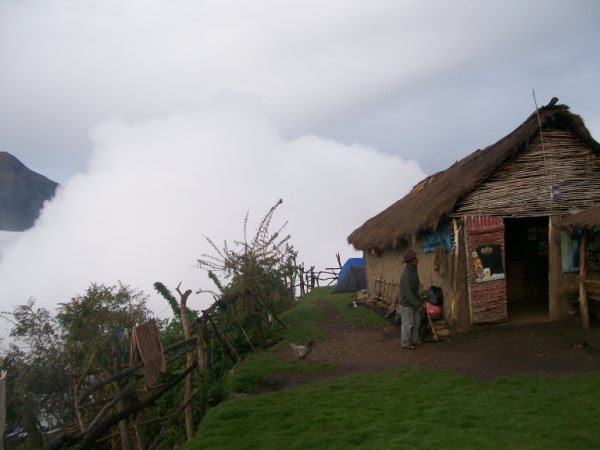
I slept perfectly that night and was first to rise the following morning. After all of our tasks were fulfilled at the campsite, we set out with a light load: small bags holding water, snacks, and camera.
During our jaunt along the trail to Choquequirao, we witnessed strong rivers and charming creeks flowing at differing degrees from places unseen uphill to much the same downhill. The vegetation was wet and muggy, a welcome change from the dry heat of the previous days. With all of this beauty, even prior to viewing any of the ruins, I began to ponder: with a place so fantastic in nature, and so comfortable and agreeable in climate, why would the Incas not have built an important ceremonial area in these parts?!
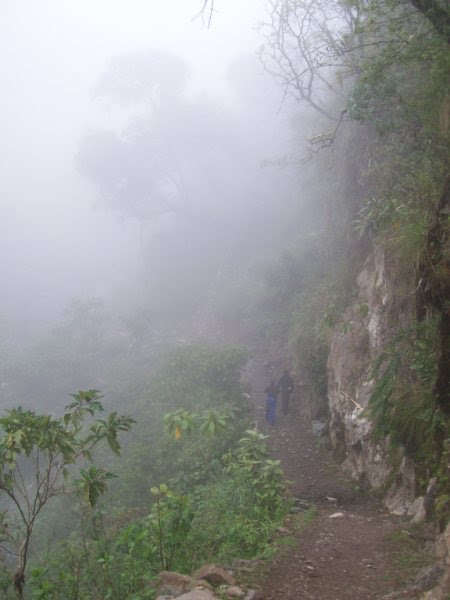
Flowing along the slight ascents and descents and through the winding trail still decorated by a lingering fog, we approached the first ruins that graced our immediate trail. What was initially a short stretch of large, stone-supported terraces, measuring about six feet tall, henceforth gave way to a entire extended network of terraces ascending up the cleared-away mountain side.

Marampata provided a majestic panoramic view, second to few. Just beyond a couple more bends in the horizontal trail was the next campamiento. And, up further in the distance, I could just barely make out the mountains containing the riches of the Choquequirao site.

Impending Jaunt to Choquequirao
It was only two-thirty in the afternoon when we reached the campamiento; we had gotten such an early start, that it felt later than it really was.


We were very comfortable at this site. Its bird-nest vantage point provided a breathtaking view of all of the neighboring mountain ranges and low-lying valleys below. A cool wind passed through our site as we ate dinner that night. We exchanged stories and jokes, while laughing intensely, just enjoying the company of one another.

I slept perfectly that night and was first to rise the following morning. After all of our tasks were fulfilled at the campsite, we set out with a light load: small bags holding water, snacks, and camera.
During our jaunt along the trail to Choquequirao, we witnessed strong rivers and charming creeks flowing at differing degrees from places unseen uphill to much the same downhill. The vegetation was wet and muggy, a welcome change from the dry heat of the previous days. With all of this beauty, even prior to viewing any of the ruins, I began to ponder: with a place so fantastic in nature, and so comfortable and agreeable in climate, why would the Incas not have built an important ceremonial area in these parts?!

Flowing along the slight ascents and descents and through the winding trail still decorated by a lingering fog, we approached the first ruins that graced our immediate trail. What was initially a short stretch of large, stone-supported terraces, measuring about six feet tall, henceforth gave way to a entire extended network of terraces ascending up the cleared-away mountain side.

We inspected the skill and precision of the Inca stone work. As I did so, I came to the terminal realization that our goal, the site of Choquequirao, the great sister of my beloved Machu Picchu, was rapidly approaching. Finally, we made it to the entry point of the main plaza of the Choquequirao site (9940 ft.), where we all joined together to congratulate one another.


The next several hours were spent calmly strolling through the various areas of the site: the well-perserved and -mantained houses, courtyards, temples, and ceremonial grounds. The fog eventually dissipated, offering us a perfect view of not only the ruin site, but of the rest of the unimaginably distant valleys that extend away and down in all three directions from the nucleus that is Choquequirao.
I promptly realized while standing at this privileged vantage point, that Choquequirao was the perfect area, like most other Inca constructions, to construct and consecrate this site. The truth was that Choquequirao, the place to which my friends and I had spent two-plus arduous days hiking, was the most astounding place I had ever seen in my life. Only two other places come close: one is in central Ecuador; the other, not surprisingly, is Machu Picchu, a very proud brother.
The Adventure’s Over: Reuniting Yin with Yang.
In actuality, the initial “quakes” began at the second night’s campamiento. The bad stomach came not on the third night but during our calmly tour of the Choquequirao site. The grand tipping-point occurred only after a tuna cake supper at our third night’s campamiento (same as the first night’s, on the first “wall”). At 3:25 a.m.-sharp, I arose and exited our tent, for that’s when the intense pangs and nascent heaves became spontaneous and uncontrollable. The same cold sweat, mixed with bile-fueled eruptions, that would rule me the following day were just beginning; this was only a warm-up for my terrible, precipitous and imminent fall from bliss.

Fast-forward past the toilsome 5,000 foot return ascent up the first wall of eternity and to my arrival at the lookout of "The Point of No Return," or Capuliyoc.
There I laid down at a covered resting spot as my entire being surrendered to its sun-shade and cool cement foundation. Up until this point, I had been vomiting blood for a good hour, and hope for holding down anything else was all but gone.
There I laid down at a covered resting spot as my entire being surrendered to its sun-shade and cool cement foundation. Up until this point, I had been vomiting blood for a good hour, and hope for holding down anything else was all but gone.
A pair of “newbies” approached and stopped in front of me before making their descent of the first wall. I, having surrendered to my super-humble state, made short of the short talk and asked the two full-health men (an American and Canadian) for any extra water that they may have had; I knew that there wouldn’t be a place for me to purchase water until my return to Cachora, two hours plus into the future.
Reluctantly, one man agreed, but only after I assured him that there would be places for them to buy water along the way. I diligently wet my bone-dry “San Luis” (a Coca-Cola owned brand, ubiquitous in Peru) water bottle, filling it and desperately drinking from it. I thanked the men profusely, and they were off.
About twenty steps on from my saviors’ exit, I spontaneously heaved up another offering to the Earth. And again. And again. And yet again. In that moment, it was futile. Everything. I needed hydration. But nothing was staying down. My body wasn’t cooperating. So I sought out solutions. Soon after, an idea came to mind: I could accumulate salt by licking the sweat off my skin and, thus, retain water!
About twenty steps on from my saviors’ exit, I spontaneously heaved up another offering to the Earth. And again. And again. And yet again. In that moment, it was futile. Everything. I needed hydration. But nothing was staying down. My body wasn’t cooperating. So I sought out solutions. Soon after, an idea came to mind: I could accumulate salt by licking the sweat off my skin and, thus, retain water!
My salt-searching expedition first led me to lick my right hand. And then my left. Next, I licked my lips and my arms. I went on to attempt to consume every centimeter of dried salt-sweat on my visible body. Though I surely and embarrassingly resembled a giddy golden retriever, I had no other choice. At this point, I couldn’t afford to lose any more water. I willfully resolved to continue on.
The trail on the other side of "The Point” was easy, smooth and a coast to the trail’s origins at Cachora. Even though I was in no state to even be alive, I found this to be satisfyingly the case. Toilsome as the day had been, I continued to walk while praying gratitude for just being able to live this whole thing out. I thanked everyone and everything in my life. I thanked my feet and legs and back for being so courageous. My stomach, esophagus, and throat for their resilience. My mind for maintaining focus throughout this newly dreadful trek.
Just then, from the ethers, a burse of inspiration emerged in the form of a favorite fruit. I began to have visions of watermelon, that juicy fruit in all of its goodness. Curiously, that would become my saving image for the two-hour tour back to freedom at Cachora. I imagined the fruit’s succulence as it encompassed my mouth, teeth, and my entire being! “W-A-T-E-R-M-E-L-O-N!!!” was my mantra as I prayed for its consumption to be my future mudra, again, and again, and again…
The trail on the other side of "The Point” was easy, smooth and a coast to the trail’s origins at Cachora. Even though I was in no state to even be alive, I found this to be satisfyingly the case. Toilsome as the day had been, I continued to walk while praying gratitude for just being able to live this whole thing out. I thanked everyone and everything in my life. I thanked my feet and legs and back for being so courageous. My stomach, esophagus, and throat for their resilience. My mind for maintaining focus throughout this newly dreadful trek.
Just then, from the ethers, a burse of inspiration emerged in the form of a favorite fruit. I began to have visions of watermelon, that juicy fruit in all of its goodness. Curiously, that would become my saving image for the two-hour tour back to freedom at Cachora. I imagined the fruit’s succulence as it encompassed my mouth, teeth, and my entire being! “W-A-T-E-R-M-E-L-O-N!!!” was my mantra as I prayed for its consumption to be my future mudra, again, and again, and again…
With each labored step forming a syllable of a much desired fruit, my pace magically increased. As I finally arrived at Cachora, I, for the first time in three-plus days, set foot on an asphalt road. And now, with this reality affirmed, and my return to Cachora a certain manifestation, I began to look up into the distance in a delirious attempt to spot any open small markets on this leisurely Sunday afternoon, a notoriously dead time.
In proper fashion, the small town was closed up for the day, and my worrying commenced anew. I questioned what I would do if I weren’t able to find and consume water. Would I be relegated to some purgatorial zone of pre-death, only left to waste away in this leisurely town without hope for being spared?! Would it be possible to dial 9-1-1 and receive that immediate attention that we are so accustomed to in the States?! In short, would I survive this hopeless battle?!

This chaotic and endless head-talk instantly dissolved upon view of the God-sent image of ice cream. It was there, hanging just above the open door of a side-street store. That ubiquitous ice cream advertisement came gloriously into view: D'anafrio. The same brand that I always strayed from given my normally resistant attitude toward overly-sweet sweets. But, today, on this most unique of occasions, I heeded its call.

The first taste was novel and reluctant, given my fear of oral refusal. In a matter of thirty minutes, while sitting peacefully alone on that park bench in the main plaza, I inhaled eight fruit pops, which sparked my quenching attack on my withering dehydration. It’s inexplicable the feeling that ran through me at this point. The stomach pangs slowly subsided as I simply basked in the goodness of these blessed fruit pops...
Although the stomach damage had been done, I knew that I would be alright. I knew that I would survive what appeared to be, just one hour prior, a truly scary situation. There, I sat. A feeling of intense stillness blew over me as I peacefully enjoyed this simple and satisfying prize at the end of this arduous experience.
So, to answer the question as to whether it was worth it to venture for three full days only on the fourth day to experience hell-on-earth so as to essentially “make the trip”: The answer, quite simply: Yes. And, I’d do it again without reservation or hesitation. Well, maybe the first three days of it anyway...
During these four days, the highest of the high and the lowest of the low were touched upon. The inevitable balance of the “ying and yang of life” is probably the best description that I can conceive of the experience. Lessons were learned. Some the hard way. Others as effortlessly as possible. No need to expand on these ideas, for all has been purged, acknowledged, and left for display, above. In sum, I recommend this trek to all, albeit short of the anti-malaria pill.
Happy Trails…

During these four days, the highest of the high and the lowest of the low were touched upon. The inevitable balance of the “ying and yang of life” is probably the best description that I can conceive of the experience. Lessons were learned. Some the hard way. Others as effortlessly as possible. No need to expand on these ideas, for all has been purged, acknowledged, and left for display, above. In sum, I recommend this trek to all, albeit short of the anti-malaria pill.
Happy Trails…


No comments:
Post a Comment